

Results
B. Demonstration of a structured approach for the restoration of black pine forests
C. Implementation of restoration measures
D. Monitoring and evaluation of the restoration
E. Dissemination and communication actions
A. Impact assessment of 2007 fire on the habitat type "(Sub-) Mediterranean pine forests with endemic black pines"
The impact assessment of fire on the priority habitat type “(Sub-) Mediterranean pine forests with endemic black pines” on Mount Parnonas is based on the detailed mapping of the burnt areas and the evaluation of the fire impacts through the use of remote sensing, geographical information systems and fieldwork.
The assessment showed that the fire of 23/8/2007 affected 9.6% of the area of the Site of Community Importance (SCI). In regard to the priority habitat type of Black pine forests, 1921 ha where burnt, representing 35.91% of the 5,350 ha it occupies in the SCI. However, there remained islands of Black pine live trees, totaled 420.1 ha, which, as seed sources, serve as forest regeneration centers.
Overall one could argue that the effect of fire on habitat type "(Sub-) Mediterranean pine forests with endemic Black pine" on Parnonas is primarily qualitative and the dominant element is the most severe impacts in the south and lower altitudes of the burnt area. The plant and animal species of Community interest do not seem to have faced irreversible consequences of the fire except the turtles that have been strongly affected. The size of the burnt area in relation to the size of the SCI and the fact that no habitat type or habitat of a species has been affected in an irreversible manner, leads to the conclusion that the fire on 23/8/2007 has not affected its integrity irreversibly. However, any new fire before continuing the recovery of the forest especially in southern and lower elevation area could cause serious harm to the integrity of the site. See the report (in Greek with English summary)
B. Demonstration of a structured approach for the restoration of black pine forests
The “Guidelines for the post-fire restoration of Pinus nigra forests through a structured approach” were developed in phases incorporating comments and improvement proposals originating from its implementation on Parnonas and from its presentation to experts and other stakeholders. At the end of 2009 the first version was released after the incorporation of comments and remarks which were given by experts who took place in the international conference “New approaches for the restoration of Black pine forests», held in Sparti-Greece from 15-16 October 2009. The second, updated and final version was released in 2013. The structured approach for the post-fire restoration of black pine trees is a five steps process. In particular:
1. Specification of selection criteria of areas prospective for restoration
2. Implementation of exclusion and ranking of areas prospective for restoration
3. Preliminary selection of areas for artificial restoration
4. Verification of the preliminary selection
5. Restoration measures
The selection criteria are: i) Exclusion criteria, such as natural regeneration potential and altitude; ii) ranking criteria (biotic, abiotic and technical) that lead to a hierarchical rating of areas to be restored.The structured approach, along with guidelines regarding the planning and implementation of post-fire emergency actions and actions increases the efficiency of the approach, comprise the deliverable “Guidelines for the post-fire restoration of Pinus nigra forests through a structured approach”. See the updated second version in Greek (with English summary) and an extended summary in English.
Another deliverable of this action is the “Proposal to restore the Black pine forests that have been affected by fires on Mount Parnonas (GR2520006)” applies the approach proposed in the guidelines and concludes with the identification of the stands to be restored, the restoration objectives and the restoration measures. Based on this, the Forest Service of Sparti will elaborate the “Technical implementation study” for restoration works on the project site (Action A3). See the proposal (in Greek with English summary)
C. Implementation of restoration measures
Restoration of 290 ha of black pine forests begun in December 2010 and concluded in March 2011. Approximately 450,000 seedlings were planted. Other 300 ha are already naturally restored with Black pine or evergreen sclerophyllous vegetation. The plantings are taking place in areas of Agrianoi and Polydroso villages. The study, assignment and supervision of the restoration was done by the Forest Service of Sparti, after a proposal that was jointly prepared with the Greek Biotope/Wetland Centre, implementing the structured approach for the restoration of burnt forests of Black pine (Action A2). The seedlings were produced in the Forest Nursery of Organi by the Directorate of Reforestation of Macedonia and Thrace, from seeds collected in 2007 by the Forest Service of Sparti. See the summary of the implementation study. See the summary of the implementation study.
D. Monitoring and evaluation of the restoration
A crucial element of a restoration project, especially in cases where habitat types and areas of the Network NATURA 2000 are involved, is the installation of a monitoring system for the evaluation of the restoration effectiveness. In Parnonas, 13 permanent plots for the monitoring of natural regeneration and 20 permanent plots for the monitoring of artificial restoration have been established (see the map of monitoring plots) and data are collected regularly. All monitoring plots have been permanently marked. See the establishment report (in Greek with English summary)
Collection for natural regeneration continued in 2012. Within the distance of 50 m from the edge of unburnt forest there was a further decline to΅0.5 plants/m2 from of 1.1 seedling/m2 in 2010 and 0.9 seedling/m2 in 2011. This decline was to be expected as long as understorey vegetation is becoming more competitive to the seedlings of Black pine.The age of parent trees seem to affect the density as long as in plots adjacent to aged trees densities of 12 seedlings/m2 have been recorded. Seedlings have been recorded up to 86 m from the unburnt trees. See the reports for 2010, 2011 and 2012 (in Greek with English summary).
From the vegetation data that were collected during June 2010 seems that the post-fire environment favour plant diversity as long as recorded plant species were twice those reported in various publications for unburnt areas. See the report (in Greek with English summary).
The monitoring of the artificial restoration showed that seddling's survival is strongly related to the altitude, as long as in the lower altotudes survival rates were low, in contrast with those in plots over 1000 m, where survival rates reach almost 80%. See the report (in Greek with English summary) and the annex with with the monitoring plots.
Overall assessment of the restoration
The data collected from the 33 monitoring plots, in combination with data derived from satellite images of 2003, 2009 and 2013, were used fir an overall assessment of the restoration of the burnt black pine forest on Parnonas. See the report (in Greek with English summary) and the annex with the photographs.
E. Dissemination and communication actions
Singposting, Leaflet, International Conference or the restoration of black pine forests, LIFE PINUS at schools, Presentations to experts, Presentation meeting of the project results, Layman's report
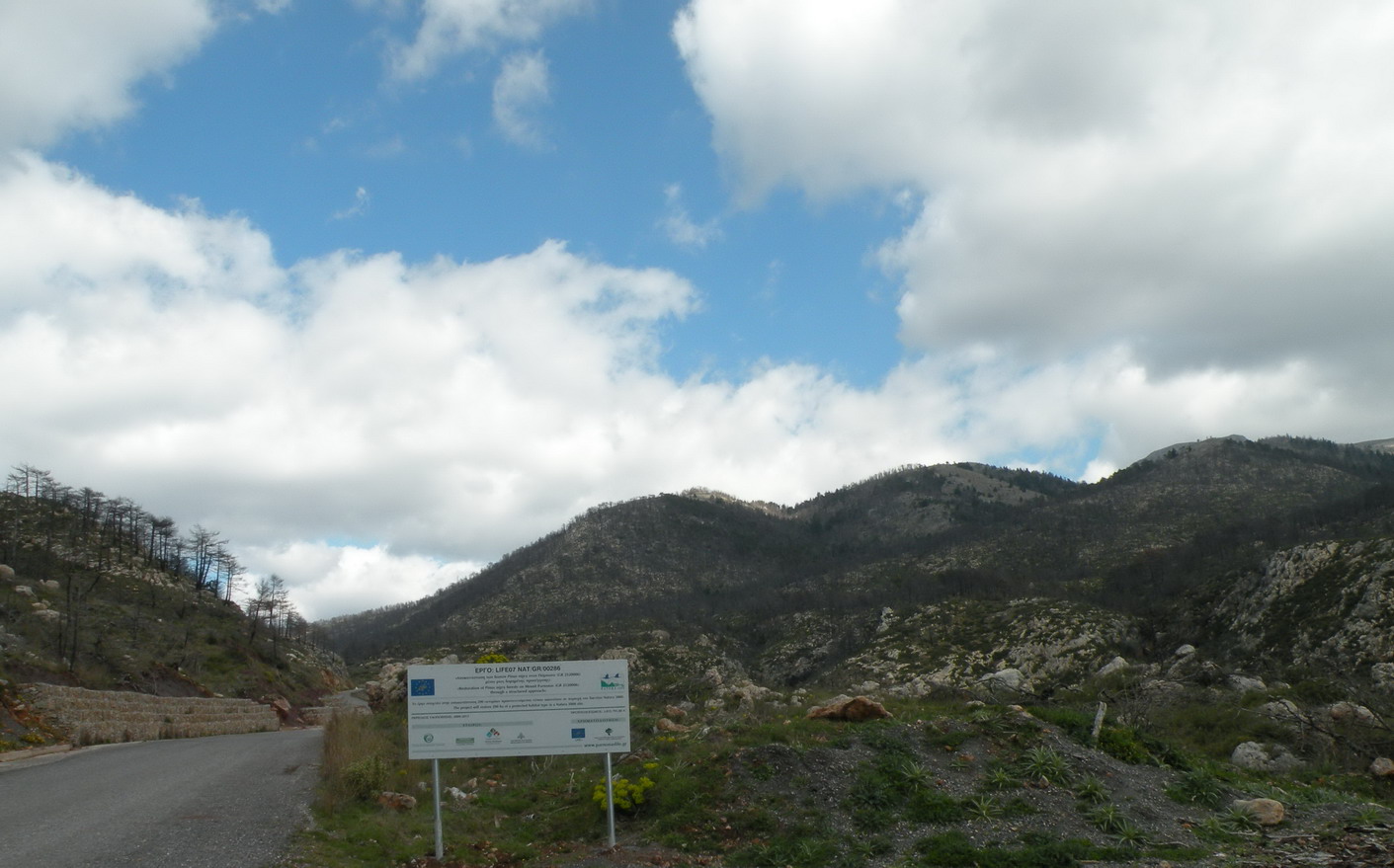
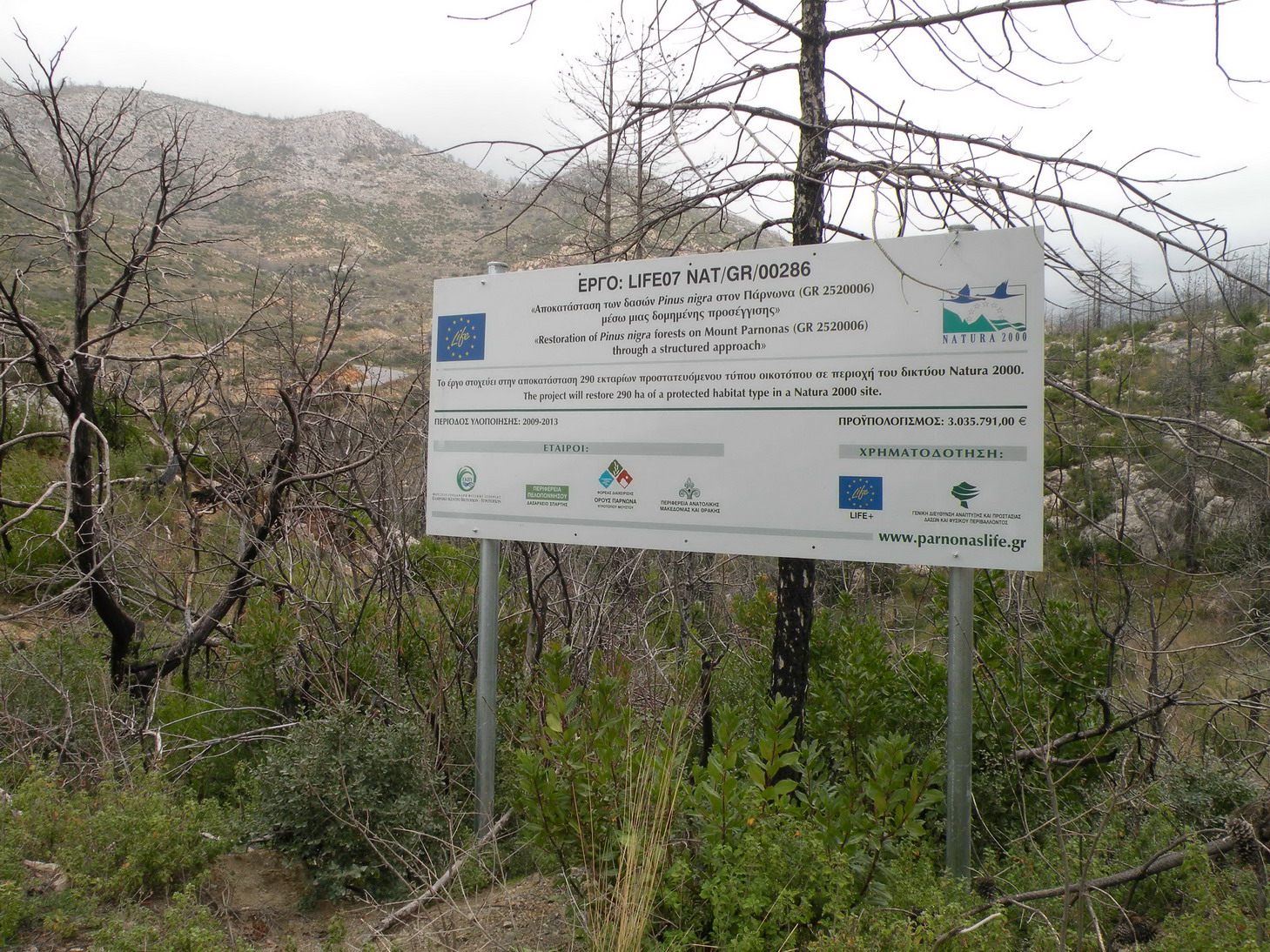
Boards on the main access roads of the area give basic information about the project.
The leaflet presents the objectives of the project, its activities and expected results and a brief description of the project area.
Conference «New approaches for the restoration of Black pine forests», Sparti 15-16 October 2009
The conference was attended by more than 100 participants from forests services, protected areas’ management bodies, local authorities, NGOs and other organizations. Presentations were given and discussions were made regarding the main futures of Black pine forests of Greece and the principles for their ecological restoration, the conditions of the Parnona’s Black pine forest after the fires of 2007, the structured approaches for the restoration of Black pine forests and for techniques that facilitates natural regeneration and artificial restoration. Participants had also the opportunity to visit the burnt area of the Black pine forest of Parnonas and further discuss on the above issues on the spot.
The key points of the conclusions are:
- Black pine forests of Greece face an increasing threat from wildfires during the last 20 years.
- Natural regeneration will always be the first option for the restoration of Black pine forests but artificial restoration will also continue to be an important tool, particularly for recently burnt areas.
- Particular attention should be paid to the timely collection of local reproductive material to a seed stock to support the artificial restoration. Improvement of the facilities of the Central Seed Storage would also support this task.
- Of particular importance is the adequate staffing of forest services required to meet growing needs for rehabilitation of burnt forest ecosystems and the establishment of forest nurseries near areas that need restoration.
Conference proceedings have already been printed and you can read them here.
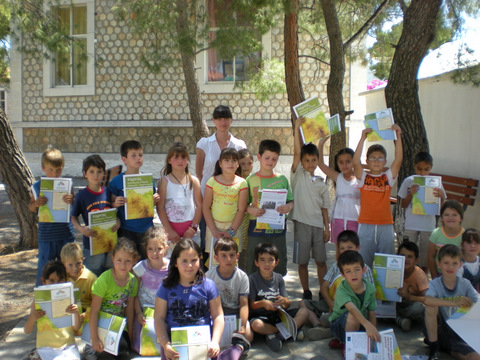
Environmental activities at Geraki Elementary School 2010
Management Body of Mount Parnon & Moustos Wetland in collaboration with WWF Hellas delivered the message of forest protection to the students of Geraki Elementary school in Lakonia, with the use of discussion and environmental activities, on Wednesday and Thursday the 26th & 27nth of May 2010. As common as it may sound we believe that the children are the future!
Presentation of Life+ Project in Kastanitsa 2011
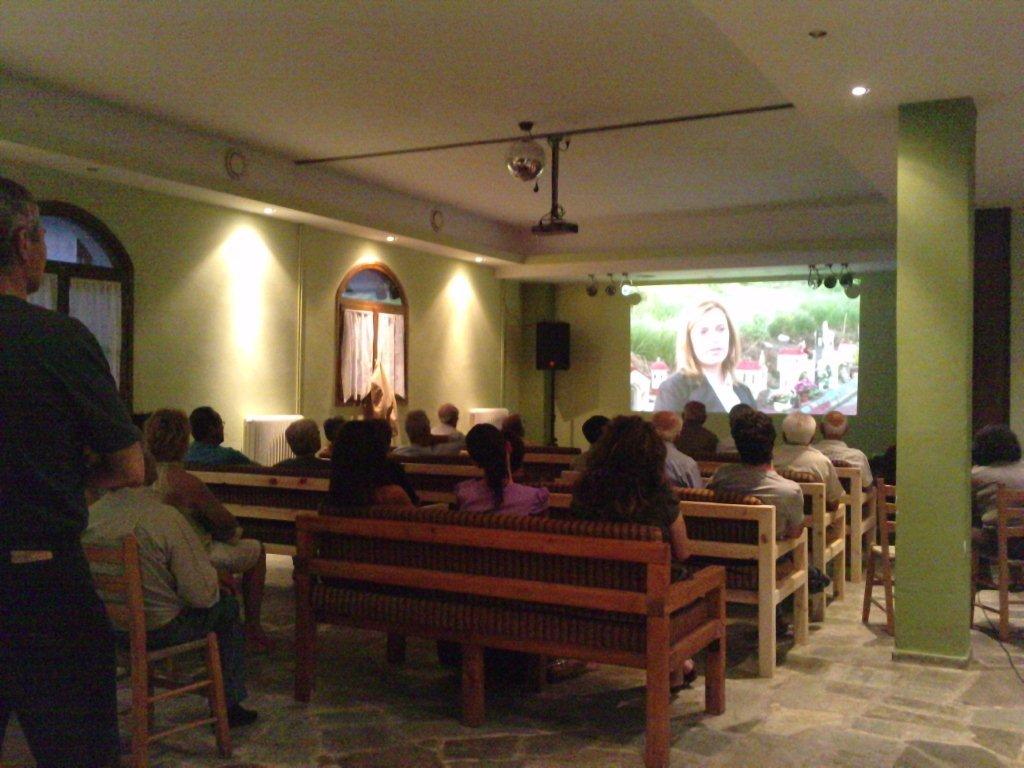
LIFE+ project “Restoration of Pinus nigra forests on Mount Parnonas (GR2520006) through a structured approach”, was presented on Tuesday the 9th of August at the Cultural Center in the village of Kastanitsa, on the occasion of the events of the "FOREST FEST 2011".
The LIFE+ project “Restoration of Pinus nigra forests on Mount Parnonas (GR2520006) through a structured approach”, was presented by the eco-guide of the Environmental Information Center of Kastanitsa, Mr. Arvanitis Diamantis and it was attended by about 50 people, residents and visitors of Kastanitsa.
The Management Body Mount Parnon & Wetland Moustos on the occasion of the "FOREST FEST’’ events, designed and printed a special informative edition in 100 copies, which was entirely distributed free of charge to residents and visitors of Kastanitsa. The edition is posted on the website of the Management Body Mount Parnonas Wetland Moustos at http://www.fdparnonas.gr/el/publications and contains information about LIFE+ project “Restoration of Pinus nigra forests on Mount Parnonas (GR2520006) through a structured approach”, the International Year of Forests, the institutional framework governing the operation of the Management Body of Mount Parnon & Moustos Wetland and other useful information.
Presentation of the project to experts
Project’s actions and results have been presented in scientific conferences and meetings and to experts in Greece and abroad. In Greece presentations took place:
- At Sparta in 2009 in the conference «New approaches for the restoration of Black pine forests» (Presentation in Greek).
- In May of 2011 and 2012 presentations with emphasis on the structured approach were given to the postgraduate Study Program in Physical Disasters organised by the Faculty of Geology and Geoenvironment of the National & Kapodistrian University of Athens (2012 Presentation in Greek).
- In November 2011 in the meeting “Restoration interventions in burnt protected areas” organised by the project LIFENAT08/GR/000533 FRAMME (Presentation in Greek).
- In December 2011 in the meeting “Conservation and enhancement of biodiversity in forests and reforested areas” with emphasis on the restoration measures organised by the project LIFE09 NAT/GR/000326 VERENIKE (Presentation in Greek).
- In May 2012 in the Invitation at the final Conference of the project LIFE07 NAT/GR/000291 "Pindos Grevena" in Grevena (Presentation in Greek).
- In October 2012 at the "Forests Technical Workshop - Experience Exchange on Habitat Recovery" conference held in Las Palmas of the Gran Canaria Islands, in the framework of project LIFE Nature INAGUA (Presentation)
The project was also presented during the meeting of Cost Action FP0701 “Post-Fire Forest Management in Southern Europe” organised in April 2010 at Valencia, Spain (Presentation) and is one of the case studies for the restoration of burnt Black pine forests in the book "Post-fire management and restoration of Southern European Forests", one of the major outcomes of the abovementioned COST Action.The project has also been included in the european database of post-fire forest management projects which has been developed in the framework of the same research action.
The project was presented in the 8th European Conference on Ecological Restoration, organised on 9-14 September 2012, in Ceske Budejovice, Czech Republic. See the presentation.
Presentation meeting of the project results in Sparta
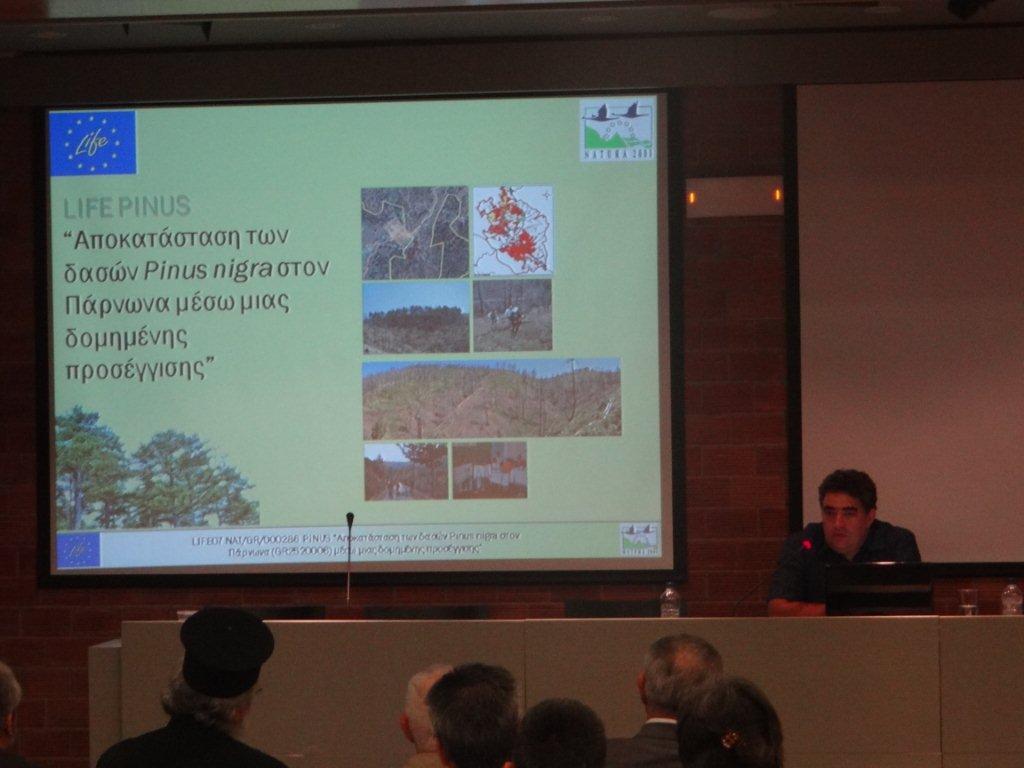
The main results of the project were presented at a scientific meeting, held in Sparta, at the Museum of the Olive and Greek Olive Oil, on 15/05/2013. The presentations of the meeting were:
- Early estimates of the measure "Restoring forestry potential and introducing prevention actions - reforestation - rehabilitation of burnt areas", especially for Pinus nigra burned areas of the Program. Stamos Ioannis, Forester, Directorate of Reforestations and Watershed Management - Special Secretariat for Forests. View the presentation here.(In Greek)
- The project activities of LIFE + PINUS for the restoration of black pine forests of Parnon. The structured approach for the restoration. Kakouros Petros, EKBY. View the presentation here. (In Greek)
- Rehabilitation of black pine forests of Parnon. Simadi Panagiota, Director of the Directorate of Forests of Laconia. View the presentation here. (In Greek)
- The legal framework for reforestation and its strategy. Ntinokas Dimitris, Director of Directorate of Reforestations and Watershed Management - Special Secretariat for Forests. View the presentation here. (In Greek)
- Installation and monitoring results of natural and artificial restoration of black pine forests of Parnon, prospects for research and documentation. Kakouros Petros and Apostolakis Antonis, EKBY. View the presentation here. (In Greek)
- Information and awareness activities of project LIFE + PINUS. Pantazi Katerina Management Body of Mt Parnon and Moustos Wetland. View the presentation here. (In Greek)
- Restoration of burned forest mountainous Mediterranean conifers. Kazanis Dimitris, Department of Biology, University of Athens. View the presentation here. (In Greek)
- Taygetos Forest - Results and early estimates from the restoration of the forest of Pinus nigra - Abies cephalonica. Sotiropoulos Giorgos, Director of the Directorate of Forests of Messinia. View the presentation here. (In Greek)
- Scenarios dissemination of bushfire at Parnon and the burnt areas of forest fire on 23/08/2007. Athanasiou Miltiades, Environmentalist. View the presentation here. (In Greek)
- Application methods for MCA to delineate areas of natural and artificial regeneration of Taygetos Forest. Aggelopoulos Panagiotis, Forester, Directorate of Forests of Messinia. View the presentation here. (In Greek)
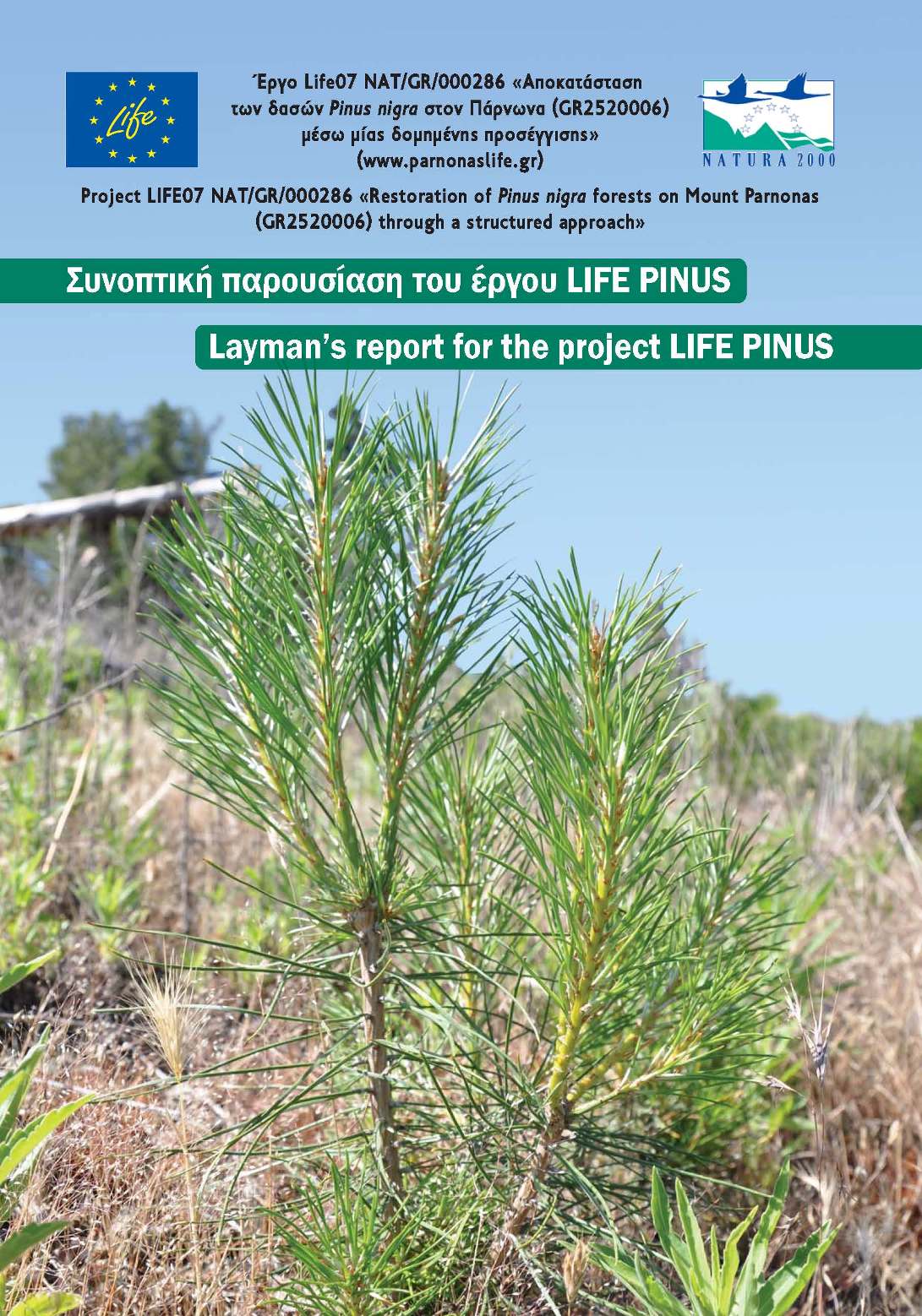
Layman's report for the Project Life Pinus
The Layman's report includes a brief project description and it's key achievements and focuses on the advantages of implementing procedures for the structured approach of black pine forest restoration. It includes illustrative sketches, drawings, maps and photographs of the area before restoration, during restoration and after. To see or download the layman's report press here.
Website of the project
The website www.parnonaslife.gr of the project presents the actions, goals and deliverables of the project.
After 4,5 years of creative work and cooperation LIFE PINUS concluded with success at June 30, 2013. Read here the final report.